
🪙The Bulletin #85: Tokenization, Term Loans, and the Week the Market Flinched + Exciting Upcoming Events!🤝
In this week's bulletin - Metropolis takes us to school in a $1.6B raise, The Nasdaq wobbles explained through a VC lens, and JP's new era of private assets 🙌


Hey, welcome back to the VWV Bulletin! Happy November, we hope you have the best one of your life! This week, we’re covering the latest news and moves in private asset modernization, tech trends, and ?. Let’s get into it! 🏃➡️
📌 For this semester, keep up with our content if you’re interested in:
Demystifying & breaking into VC
Finding opportunities in the start-up world
Keeping up with VC investment news at Brown & beyond (pro tip: this is essential to breaking in and finding opportunities)
Enjoy the Bulletin!
🚘Metropolis: A Term Loan as a Superpower
Picture this: you roll into a garage—no gate, no ticket, no kiosk. You just park, leave, and a receipt shows up. That’s Metropolis: cameras + software recognize your plate, match it to a stored payment method, and charge you automatically. Operators get higher throughput and lower labor; drivers get in/out without thinking. Founded in 2017, the company vaulted from startup to scale operator after its 2024 take-private of SP+ (the century-old parking giant), giving Metropolis control of 4,000+ locations and a national footprint to deploy its system at pace.
Moreover, they just raised $1.6B to scale that model, through a very important and demonstrative combination of financing: a $500M Series D at roughly $5B valuation, plus a $1.1B Term Loan B led by JPMorgan. Moreover, the source of those funds is largely aimed towards accelerating site conversions and pushing into adjacent “drive-in, drive-out” venues like those found in the hospitality industry.
💵 The Beauty of a Good Ol’ $1.1 Billion Term Loan B
That mix of equity and syndicated debt is a fascinating and massive reminder of why awareness in financial engineering is so important. Since the Metropolis model throws off predictable cash flows and maintains contracts on real assets which a lender can underwrite and get repaid from, high debt leverage became both feasible and attractive for both the company and lenders. Specifically, as lenders look for site-level paybacks, healthy margins, and, of course, collateral in the form of hardware, contracts, and cash accounts.
This capability is especially powerful and important to recognize in today’s market. With late-stage equity both expensive and (recently) volatile, quickly see multiples shaking, rounds taking longer, and terms becoming more restrictive. For companies like Metropolis, this means that debt financing can still be cheaper than the effective cost of equity (and, of course, non-dilutive!). In this case, it allowed Metropolis to fund expansion without repricing the whole company in a choppy market
The key takeaway here is not just in the dollar amount of the raise, but how it was structured and why that was the case. Metropolis taking advantage of their collateral unlocks scale: equity funds the software, teams, and new categories, and debt funds the repeatable installs that produce steady transactions. Moreover, given the past week’s haziness where high-multiple software was choppy, this is the template worth noting: AI that directly prints cash and proves site-level payback can be scaled with debt, not just the investor hype wave—a real advantage when we are not sure how far we have departed from financial reality.

🎞️ The Big Put (& the Nasdaq’s Speed Bump)

Tech just logged its worst week since April, with the Nasdaq off ~4% as AI-heavy names shed hundreds of billions in market cap. The narrative is reflective of what you might expect: historically sky-high valuations were stress-tested by fresh doubts about near-term ROI on the AI capex wave and softer macro reads. And, if you’ve been reading the news, you know that this materialized most publicly via Michael Burry, as Scion’s recent 13F disclosed about $1.1B of put options tied to Palantir and Nvidia as of Sept. 30, which instantly became the investor’s hand-wavy example for market overcommitment.
Still, as the week came to a close, both NVDA and PLTR saw their stock price (mostly) rebound. So what actually changed? Mostly, confidence. The market is beginning to show its signs of uncertainty as to how much AI growth is already priced in, and how quickly capex will translate into visible returns. And, with skyrocketing companies like PLTR trading at astronomical multiples like ~8.51 PEG, there is a quantifiably razor-thin margin for error or delay.
💰Ripple Effect to Private Markets…
While the short-lived nature of the Nasdaq drawdown keeps VC out of direct impact, there is still an important takeaway: when public comps compress and sentiment wobbles, late-stage price discovery stretches out, crossover demand cools, and boards get more cautious about printing new highs without equally high-quality revenue. IPO math tightens for the same reason: stock-as-currency M&A gets stingier when acquirer paper is softer.
Likewise, the consumer/investor mood isn’t helping. Sentiment gauges have skidded from summer highs, with bearish readings back in the mid-30s. That mix of elevated valuations, wobbly mood, and great big buzzwordy headlines raises the odds of sharper moves in both directions, as we just saw with the bounce.
Thinking about what could be: if the drawdown in tech multiples were to extend, the effects would compound beyond headline names. Direct entrants like late-stage software, AI, and fintech companies would see valuation pressure filter into their own fundraising terms and exit math, while the “picks and shovels” layer (i.e. semiconductor suppliers, data-center operators, and infrastructure software) would feel it through slower order growth and tighter capital budgets. In other words, a softer public market does not just re-adjust that sentiment number: it recalibrates the private-market cost of capital all along the stack, from model builders to the vendors supplying their compute.
❓So, Everything Goes Back to Normal?
Ultimately, Burry’s bet didn’t change the market fundamentally, but he did irrevocably prove a possibility. The week’s drawdown (and the quick partial snap-back) is a reminder that AI leaders can trade like fairytale stocks at these multiples. Expect higher near-term volatility as the market tests how much AI growth is already priced and how quickly the capex rollout pays off, with an effect that is not incredibly detrimental to VC but certainly forces conscious and deliberate strategy the narrative and mission founders perpetuate.
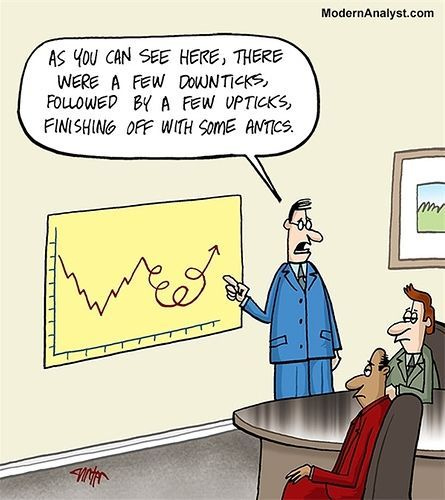
🏦JP’s Great Tokenization of the Capital Call

Imagine Jamie, a private-bank client committing to a new PE fund. He signs docs, wires on a capital call, and excitedly waits for whatever amount of time it takes for liquidity to flow through. But where does that cash go, exactly? Colloquially, that cash sits in limbo while back offices pass PDFs, reconcile spreadsheets, and update the register. Days later, units finally settle: reporting lags, secondaries are a hassle, and framing the position as collateral is basically a separate project. The cause of this delay is much less about the nature of the asset class, but rather the whitepaper which underpins it.
Enter JP Morgan’s tokenization of private equity funds. Here, instead of treating cash and fund units as entries in separate ledgers maintained by banks, administrators, custodians, etc., JP represents both legs as programmable tokens on its permissioned blockchain. The bank’s service handles onboarding and eligibility checks, bestows tokens that represent fund interests via a 1:1 cash to unit ownership, and uses a smart contract to swap value simultaneously. Thus, settlement shifts from days of ambiguous paperwork to near-instant. Practically, this means fewer operational breaks, a single auditable state shared by the bank and administrator, and a cleaner pathway to things investors actually want: faster entry, clearer entitlements, simpler secondaries (among whitelisted holders), and the ability to pledge positions without re-papering the world.
⚙️How It Works
1: Investor wires the cash leg ($) → 2: it’s reflected on the decentralized/private blockchain as by appending the ledger→ 3: a smart contract instantly verifies eligibility/terms and exchanges for the fund leg (units of the fund) → 4: the investor receives those 1:1 tokenized units representing legal ownership
🙋♂️ Why Should Investors Care?
Faster settlement reduces cash drag between wiring and being “in.” Positions update in real time, improving portfolio reports and risk. Because the rules that used to live in side letters and emails—lockups, transfer restrictions, investor classes—are embedded in code, investors get clearer, automated answers to “what can I do with this position?” Over time, that means cleaner transfers, financing options, and on-chain distributions that actually show up when they’re supposed to.
🙋♀️ Why Should Managers Care?
A shared ledger collapses reconciliation across the GP, admin, custodian, and distributor. Cap tables update programmatically, compliance runs as part of the transaction rather than after it, and investor communications/distributions can be scripted. And, because of the immediate ownership and time-efficiency transfer, tokenization enables significant collateral mobility: once ownership is native-digital, those tokens can be borrowed against or used to trade on margin intra-day without shuttling the underlying asset across legacy systems: a testament to the potential and speed of the “rails” supplied via JP’s blockchain.
❓ What Comes Next?
Importantly, this is not a consumer-facing product yet: it’s infrastructure modernization, turning alternatives from legacy-style workflows into software-optimized ownership and settlement. The platform remains limited to institutional and UHNW clients under eligibility rules embedded in its smart contracts. We’re seeing it emerge first in private markets, where the gains—speed, accuracy, collateral mobility, and auditability—are most obvious, but the same logic is spreading across traditional funds as well: BlackRock has begun issuing tokenized money-market funds on public blockchains, Franklin Templeton offers a tokenized U.S. government MMF on Stellar and Polygon, and WisdomTree is experimenting with on-chain fund shares for portfolio tokenization. As more managers adopt these rails, capital calls, subscriptions, and secondaries, start to feel less like paperwork—and more like products: instant, programmable, and interoperable.
🚨 Upcoming: Ask Me Anything With Michael Elnick (Co-Founder of Tegus)

Interested in startups, entrepreneurship, or the journey of building a billion-dollar company from scratch? Join us for an open conversation with Michael Elnick ’12, co-founder & former co-CEO of Tegus, as he shares insights from founding and scaling the company all the way to its $930 million acquisition by AlphaSense.
Learn firsthand what it takes to grow a startup, lead a team through hyper-growth, and navigate the challenges of entrepreneurship and leadership. Bring your questions about startups, scaling, or venture building for a candid, interactive discussion. Dinner will be served!
➡️ RSVP Here!
WHEN/WHERE:
Monday, November 17th, 6:30–7:30 PM ET
Liz Lange Lecture Hall 2nd Floor, (1 Euclid Ave, right above Shake Shack)
Hosted by:
Brown EP and Van Wickle Ventures
🚨 Upcoming: VC Panel - Inside the Investor’s Perspective
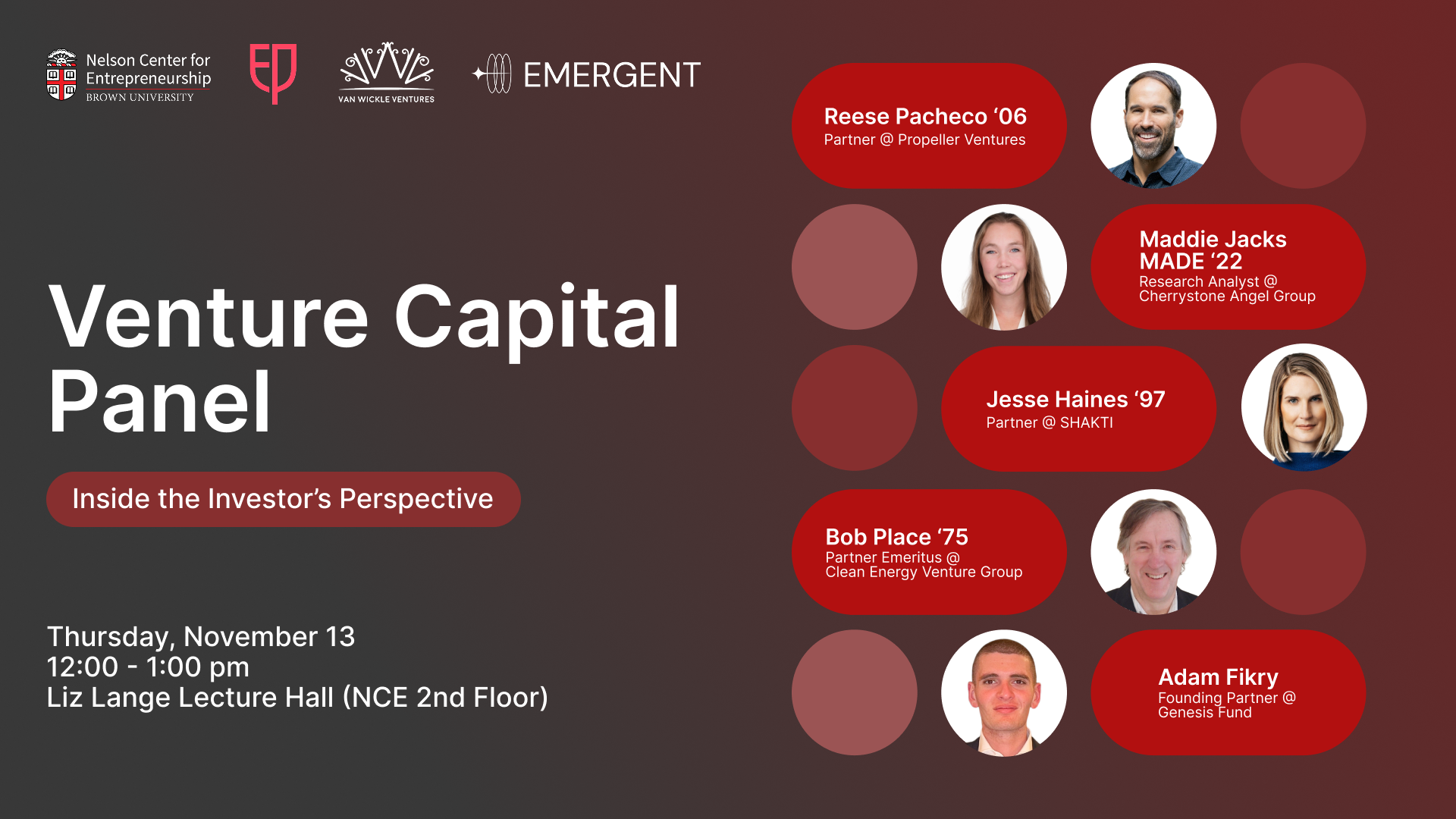
Curious about venture capital and what investors look for when backing startups? Join us for a conversation with Brown alumni now leading across the VC landscape—from early-stage funds to clean energy investing! This panel will offer an inside look into the investor mindset, deal evaluation, and how to break into the industry. Hosted by VWV Co-President Daniel Lee!
Panelists include:
Reese Pacheco ’06 — Partner, Propeller Ventures
Maddie Jacks ‘22 — Research Analyst, Cherrystone Angel Group
Jesse Haines ’97 — Partner, SHAKTI
Bob Place ’75 — Partner Emeritus, Clean Energy Venture Group
Adam Fikry — Founding Partner, Genesis Fund
WHEN/WHERE:
Thursday, November 13th, 12:00–1:00 PM ET
Liz Lange Lecture Hall 2nd Floor, (1 Euclid Ave, right above Shake Shack)
Hosted by:
The Nelson Center for Entrepreneurship, Brown EP, Van Wickle Ventures, and Emergent
🆙 We’re Updating Our Website
We love our website, and want to make sure it is accurate and up-to-date. Please let us know through this form if you are a part of the VWV team (Investment Committee, Advisors, Alumni) and have changes you wish to make to your personal profile.
That’s it for this week, feel free to email me jack_j_connolly@brown.edu with any thoughts or inquiries! 💌
Follow us:
Instagram: @vanwickleventures
Twitter: @VanWickleV